May 14, 2026
NHL Franchise Cuts Movement Screening Time in Half
See how a Western-Conference NHL franchise used Revenite to cut range-of-motion screening time by 50% while scaling athlete movement assessments.
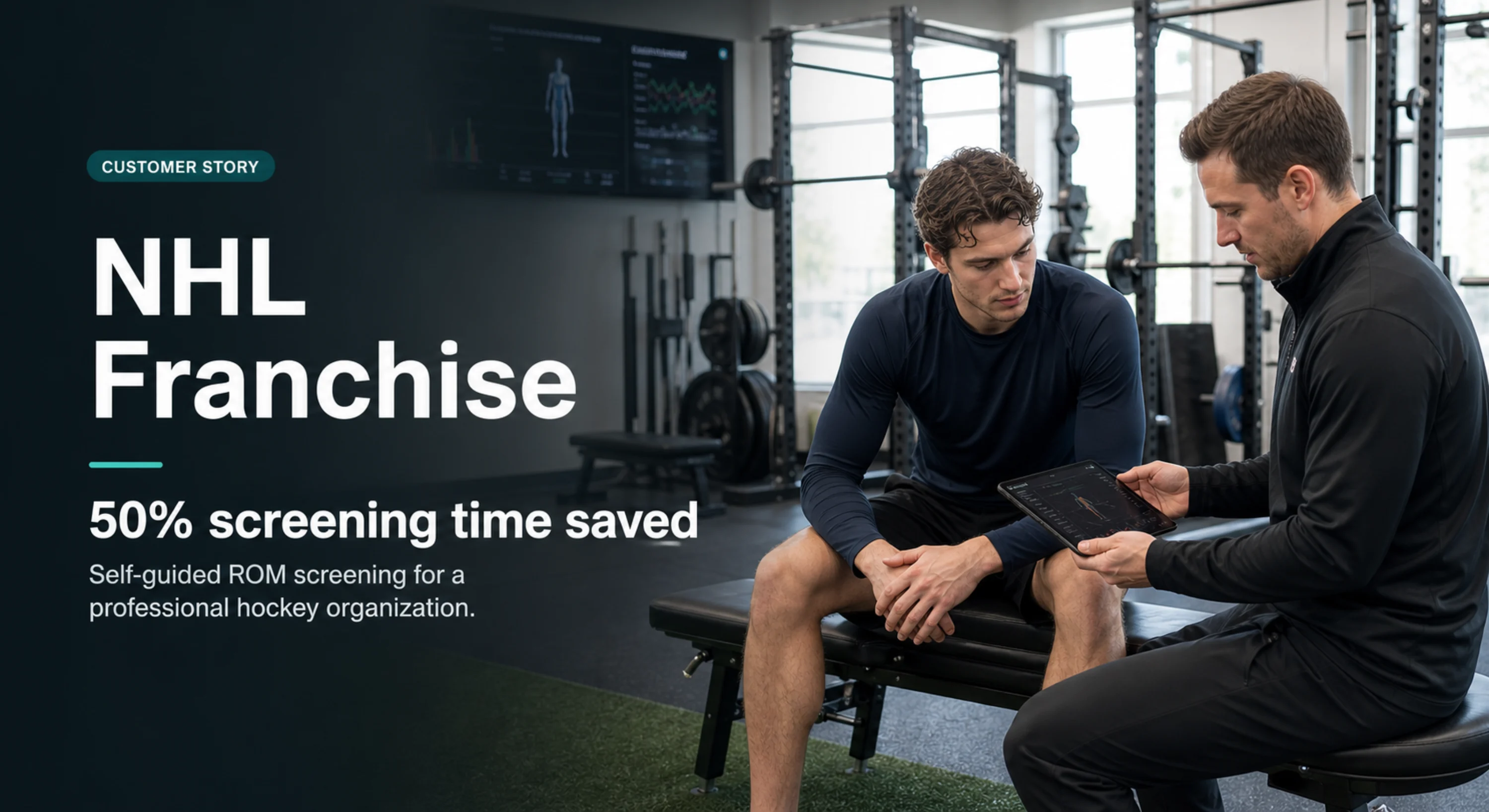
A Western-Conference NHL franchise uses Revenite to run self-guided range-of-motion screenings across its player development system. In a head-to-head comparison of 20 athletes and 10 ROM measurements, the team cut screening time from 58 minutes to 29 minutes while keeping results consistent and reliable for staff review.
About the Organization
The organization is a professional NHL franchise with a multi-tiered player development system that spans its major league roster, minor league affiliate, and prospect clubs. The performance staff is responsible for screening and monitoring athlete movement health across all levels of the organization.
That creates a familiar challenge for high-performance teams: the athlete population is large, the testing needs to be repeatable, and staff time is limited.
The Challenge: Manual Screening Was Too Slow to Scale
Professional hockey requires rigorous movement screening. The team needed to assess range of motion across a large player population, from the major league roster to prospects. Their existing process relied on a handheld ROM device, which required staff to manually test athletes one joint and one measurement at a time.
That approach worked, but it did not scale.
As the team's Associate Director of Player Performance Development put it:
"We don't have the man hours to conduct our traditional testing at all or very often."
The performance team needed a faster way to collect objective movement data without adding headcount or sacrificing staff confidence in the results.
The Revenite Workflow: Self-Guided Kiosk Screening
The team set up a dedicated in-person movement screening station in its training facility. Players scan a QR code, step in front of a screen, and complete the assessment independently.
Revenite guides each athlete through the movements with audio and visual cues, captures the data automatically, and sends results to a centralized dashboard for staff review. Players can rotate through the station efficiently while coaches and performance staff focus on higher-value work.
For a hockey organization managing multiple rosters, that matters. The workflow turns movement screening from a staff-heavy manual process into a repeatable athlete check-in that can fit into the normal rhythm of training and development.
The Result: 58 Minutes to 29 Minutes
To validate the workflow, the team ran a head-to-head comparison:
- 20 athletes screened
- 10 range-of-motion measurements
- Half screened with the traditional handheld device
- Half screened with Revenite
The comparison showed:
- 50% time savings: Manual screening took 58 minutes. Revenite took 29 minutes.
- Consistent, reliable results: The team found that both methods produced results they could use for athlete screening.
- Preferred screening method: Revenite became the team's go-to tool for player movement screenings.
The practical impact is simple: the performance staff can screen more athletes more consistently and review movement data across the roster without turning every screen into a manual staff bottleneck.
Why This Matters for Sports Performance Teams
Staff-to-athlete ratio is one of the biggest constraints in sports performance. Teams need objective data, but the capture process often takes too much time. When movement screening is too slow, it happens less often than it should.
Revenite helps performance teams standardize that capture step. Athletes can complete guided assessments, results flow into the dashboard, and staff can review movement data at scale. That same workflow can support preseason baselines, development check-ins, return-to-play context, and remote or hybrid monitoring when athletes are not all in the same facility.
For teams evaluating AI movement assessment software, the lesson from this NHL case study is not just that screening got faster. It is that faster screening made consistent testing more realistic across a larger athlete population.
What Performance Staff Can Take Away
This NHL organization did not need a more complicated workflow. It needed a faster, more repeatable way to collect movement data across multiple rosters.
That is where Revenite fits for sports performance teams: guided assessments, objective ROM and functional movement data, centralized reporting, and flexible screening workflows that work in person or remotely.
If your staff is trying to screen more athletes without adding more manual testing time, Revenite can help turn movement assessments into a scalable operating system for athlete monitoring.
Frequently Asked Questions
How much time did the NHL franchise save with Revenite?
In a head-to-head comparison of 20 athletes across 10 range-of-motion measurements, the team reported that manual screening took 58 minutes while Revenite took 29 minutes.
How do players complete movement screenings with Revenite?
The team uses a dedicated kiosk screening station. Players scan a QR code, step in front of a screen, and complete guided assessments while Revenite captures the results automatically.
Does Revenite replace performance staff?
No. Revenite helps automate repeatable data capture so performance staff can spend more time reviewing results, coaching athletes, and making decisions.
Does Revenite require a manual goniometer?
No. Revenite captures range-of-motion and functional movement data through guided assessments without requiring a staff member to manually hold a device to each joint.
Want to see how Revenite can support your athlete screening workflow? Book a demo.